
These days, it's hard not to notice how rapidly artificial intelligence (AI) is changing the world around us. It's no longer just a futuristic concept or something confined to tech labs — AI has become deeply embedded in our everyday lives, often in ways we don’t even realize.
Personally, I’ve found myself using various AI tools more and more, whether for work, when I need to process large amounts of information, or simply when I’m looking for a quick summary. At first, it all felt a bit intimidating. But to my surprise, once I tried it a few times, I discovered how simple and intuitive it really is. And more than that, I realized just how much easier — and more efficient — it makes things.
What used to take hours now takes minutes. What felt overwhelming before now feels manageable. AI has become a kind of personal assistant that doesn’t just follow instructions, but anticipates my needs, organizes my tasks, and gives me insights I didn’t know I needed. In short, it’s become a quiet but powerful partner in my daily life.
Of course, I do have concerns. Like many people, I sometimes wonder, “Is this really the right path?” or “What happens if we rely on AI too much?” These are valid questions, and I think they’re worth asking. But when I look at what I’ve experienced firsthand, I can’t deny the benefits. The value I’ve gained from AI already feels greater than the uncertainty it brings.
To me, AI is becoming more than just a tool — it feels like a companion for the future. One that finds information for me, guides me through unfamiliar territory, and helps me make better, faster, more confident decisions. It’s not about replacing human effort, but enhancing it in ways we couldn’t imagine before.
As we stand on the edge of a new era, I find myself wondering:
What kind of relationship will we build with AI in the years ahead?
That question, in itself, opens up an exciting — and very human — journey.
Act I: The Return of Jony Ive — OpenAI Goes All-In on Hardware
In May 2025, OpenAI made headlines by acquiring ‘LoveFrom io’, a design studio founded by former Apple Chief Design Officer Jony Ive, for a reported $6.5 billion.
This move was more than just a high-profile acquisition — it was a strategic transformation. OpenAI signaled that it no longer wanted to be seen as a software-only company. By bringing in Apple’s iconic design philosophy and the emotional depth of product UX, OpenAI is moving toward owning the AI hardware ecosystem of the future.
The LoveFrom team includes some of the most influential product designers in the world, including Evans Hankey and Tang Tan, who previously led the design of the iPhone, Apple Watch, and iPad.
📌 Translation: OpenAI is no longer just building apps — it wants to become the “Apple of the AI age.”
Act II: A New Paradigm Called Ambient Computing
At the heart of OpenAI and Jony Ive’s partnership is a new computing vision: Ambient Computing. This isn’t about flashy screens or voice assistants — it’s about technology that fades into the background, while seamlessly understanding context and assisting users in real time.
Imagine a world where:
- You don’t have to ask for help — AI already knows what you need.
- You’re not “using” a device — it’s just there, like oxygen, working quietly in your favor.
- Interaction is natural, subtle, and emotionally intelligent.
Expected product formats include:
- AI-powered pendants or brooches
- AR glasses with real-time contextual awareness
- Wearables that feel like accessories but think like companions
📌 Design Insight: The goal is not just to deliver functions, but to design an emotional, human-centered experience. AI isn’t just answering questions — it’s blending into your world.
Act III: The Real Battle Begins — Platform Control
With this hardware shift, OpenAI has fully entered a new competitive arena — not just against Anthropic or Google DeepMind, but now against Apple, Meta, Samsung, and even hardware-centric giants like Sony and Huawei.
Key moves include:
- Investment in Humane, the AI wearable startup
- Development of a vertically integrated ecosystem from ChatGPT to APIs to devices
- Reported $40 billion in funding, fueling hardware R&D and component procurement
While Apple remains cautious about AI and Google focuses on Android-AI integration, OpenAI’s approach is bold, risky, and end-to-end. From core models to chips to interface design — they want control over everything.
📌 Strategic Insight: This isn’t just a hardware battle. It’s a war for platform dominance — across UX, OS, devices, APIs, and trust.
Act IV: Industry-Wide Opportunities & Challenges
This new AI hardware movement won’t just impact OpenAI. It’s already reshaping the global tech supply chain. Here’s how:
Massive Demand for Miniaturized, High-Performance Components
AI devices will need ultra-compact sensors, cameras, microphones, and power-efficient chips. Specifically:
- Edge-computing processors
- Low-power, real-time multimodal AI chips
- 3D vision sensors, MEMS microphones
- Integrated battery and power management modules
📌 Opportunity: Companies with expertise in precision manufacturing, advanced packaging, and miniaturization will become critical suppliers in this emerging value chain.
Strategic Rise of Emotional UX & Design Studios
The return of Jony Ive and his team signals the rising value of emotional design and human-computer interaction (HCI).
- Interfaces must feel intuitive, not just functional
- AI needs to be emotionally responsive, not just smart
- Designers who can create digital empathy will lead the next wave
📌 Opportunity: Design studios and product consultancies with expertise in emotion-aware UX, haptics, and real-world behavior mapping are poised for global collaboration.
Supply Chain Shake-up — New Ecosystem = New Players
Smartphone supply chains were locked in by legacy players: Apple, Samsung, Qualcomm, TSMC.
But AI devices are forming a completely new hardware stack, which includes:
- Custom chips by AI companies themselves
- New operating systems (not Android or iOS)
- Integrated design-manufacturing processes
📌 Opportunity: Companies with flexible production, AI-optimized firmware, and real-time customization capabilities may form direct relationships with AI-first device makers.
Evolving Global Regulations Around Embedded AI
Europe and the U.S. are shaping policies around AI-integrated devices, demanding:
- Transparency in decision-making
- Explainability of algorithms
- Clear user consent and override mechanisms
📌 Risk/Opportunity: Compliance with these standards requires early-stage governance features. Vendors offering privacy-by-design tools, XAI (explainable AI) models, and AI auditing solutions will gain major strategic advantage.
Market Insight Snapshot
- The global wearable AI device market is projected to exceed $150 billion by 2028
- A paradigm shift from smartphones to ambient computing is already underway
- Software companies are becoming hardware designers — reshaping the entire tech value chain
OpenAI Company Analysis Report (As of 2025)
Business Overview

- Founded: December 8, 2015
- Founders: Sam Altman, Elon Musk, Ilya Sutskever, Greg Brockman, among others
- Headquarters: San Francisco, California, USA
- CEO: Sam Altman
- Industry / Products:
- Artificial Intelligence R&D
- GPT series (GPT-3, GPT-4, GPT-4o), ChatGPT, DALL·E, Whisper, Codex, Sora
- Revenue Model:
- API usage fees (via OpenAI platform and Azure OpenAI Service)
- ChatGPT Plus subscription
- Custom enterprise solutions
- Core Customers:
- Both B2C (ChatGPT users) and B2B (developers, enterprises, governments)
OpenAI is a leading force in artificial intelligence research and commercialization, offering a diverse portfolio of AI products and platforms with wide application across sectors.
Industry & Market Analysis
- Industry CAGR:
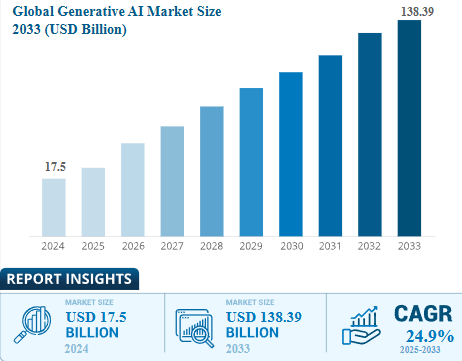
- Global AI market is projected to grow at 24.9% CAGR from 2025 to 2032.
- Market Size Forecast:
- From $17.5B in 2024 to $1.38T by 2033
- Key Trends:
- Generative AI boom (LLMs, image/video models)
- Autonomous agents and AI copilots
- Model optimization and cost-efficiency
- Foundation model race (GPT vs Claude vs Gemini vs open-source)
- Competitive Intensity (Porter’s 5 Forces):
- High entry barriers (data, compute, talent)
- Low substitution threat
- Medium rivalry: Anthropic, Google DeepMind, Meta, Mistral, xAI, etc.
The AI space is rapidly expanding, with OpenAI at the center of the foundation model wave. Competition is fierce but OpenAI’s early mover advantage and deep partnerships (notably with Microsoft) sustain its lead.
Financial Analysis
| Item | 2023 | 2024 | 2025 (Estimate) |
|---|---|---|---|
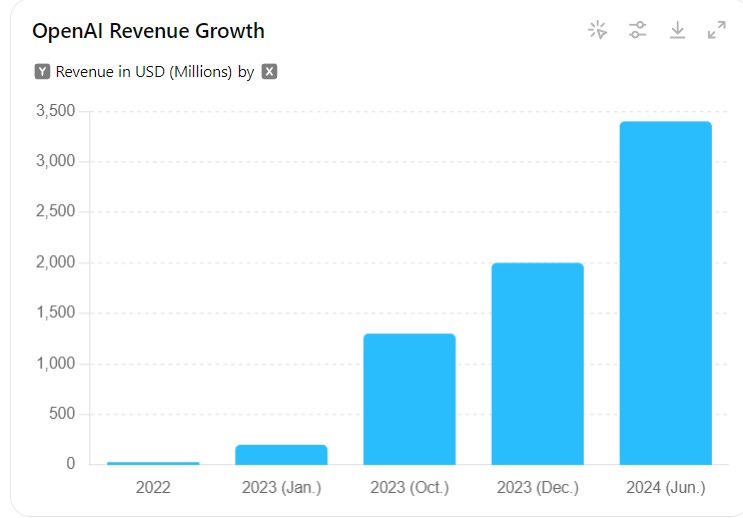
| Revenue | $200M | $3.4B | ~$12.7B |
| Annual Recurring Revenue (ARR) | – | $4.9B | – |
| Net Profit | – | Not Disclosed | Not Disclosed |
| Free Cash Flow | – | Not Disclosed | Not Disclosed |
| Valuation | – | $157B | ~$300B (rumored) |
In 2024, OpenAI reportedly hit $4.9B in ARR, with rapid enterprise adoption and API consumption.
(Source: Sacra)
SWOT Analysis
| Factor | Description |
|---|---|
| Strengths | Market leadership in foundation models (GPT), strong partnership with Microsoft, product ecosystem (ChatGPT, APIs, Whisper, DALL·E, Sora) |
| Weaknesses | High operating costs, no clear path to profitability yet, leadership and alignment challenges |
| Opportunities | Exploding enterprise AI demand, international market expansion, hardware and embedded systems |
| Threats | Rising competition (Anthropic, Google, xAI), regulatory scrutiny, data privacy and IP litigation risks |
Competitor Analysis
| Metric | OpenAI | Anthropic | Google DeepMind | Mistral AI |
|---|---|---|---|---|
| Flagship Model | GPT-4 / GPT-4o | Claude 3 | Gemini 1.5 | Mistral / Mixtral |
| Model Performance | Top-tier across tasks | Safety-focused | Multimodal emphasis | Efficient open-source |
| Distribution Model | ChatGPT, Azure, API, Enterprise | API access | Integrated in Google ecosystem | Open-source first |
| Branding | Very strong (global B2C reach) | Strong in safety narrative | Part of Google brand | Rising in Europe |
| Research Focus | AGI, multimodal, alignment | Constitutional AI, scalable oversight | long-term AI alignment | open-weight performance |
OpenAI differentiates by combining best-in-class models with strong distribution via ChatGPT and Microsoft Azure. Its competition is rising fast but lacks its scale and integration.
10-Year Growth Forecast (2025–2035)
2025–2030:
- Projected annual revenue growth: 30–35% CAGR
- ChatGPT enterprise use and multimodal agent expansion
- Azure OpenAI integration solidifies enterprise adoption
2030–2035:
- Growth moderates to 15–20% CAGR
- Market saturation in developed regions, but expansion continues in AI agents, robotics, and language-native UX (natural interfaces)
OpenAI is likely to become one of the foundational infrastructure providers for enterprise and consumer AI, akin to what AWS is for cloud.
Strategic Takeaway
“OpenAI is not just an AI research company — it’s becoming a full-stack AI platform provider for the next digital transformation wave.”
Designing the Next Ecosystem
This isn’t about building devices.
It’s about building a future.
With Jony Ive’s design philosophy and OpenAI’s AI leadership, the company is rethinking what digital companionship can look like. This move will likely reshape how we interact with technology, work, and even ourselves in the coming years.
Smartphones changed how we talk.
AI devices will change how we think.
The companies — and countries — that prepare now will be the ones who shape this next revolution.





 Boss Brief
Leave a comment