

      These days, it feels like AI is everywhere. From voice assistants and email summaries to content recommendations, image generation, translation, and task automation — AI has quietly become a part of our everyday lives.
It’s not just technology anymore; it’s part of how we live, work, and interact with the world.
And yet, somewhere in the back of my mind, a question keeps surfacing:
“I use AI every day… but where does it actually live? How does it work?”
That question led me down a path of curiosity — and what I found surprised me.
Every question we ask an AI, every image it generates, every document it rewrites — it all has to be stored, processed, and delivered somewhere. That “somewhere” is the AI data center: a physical, massive, energy-hungry digital brain.
These are not just servers humming away in the background.
They are critical hubs that power the AI we interact with daily. They hold our queries, cache our generated content, run massive models, and ensure that answers arrive in milliseconds — reliably, securely, and constantly learning in the background.
And then I realized something important:
If we’re going to use AI every day — in our homes, in our work, in our thoughts — then maybe we also have a responsibility to understand how it works, where it runs, and what kind of infrastructure holds it all together.
Because without these data centers, and without the complex web of connectivity and compute behind the scenes, none of what we consider “AI” would actually function.
So in this post, I decided to find out:
Where does AI really happen?
What does it take to run it?
Who are the companies building the foundation of this intelligent future?
Let’s explore together.
Artificial intelligence (AI) is no longer just a buzzword — it’s the foundational technology reshaping economies, redefining industries, and restructuring how we build, deploy, and interact with software.
But while much of the public attention focuses on AI models like ChatGPT, Gemini, and Claude, the less visible — yet arguably more critical — foundation of AI is its infrastructure: the data centers, interconnects, GPUs, and energy systems required to power today’s compute-hungry models.
At the core of this transformation lies a new generation of hyperscale AI data centers, led by U.S. tech companies and backed by trillions of dollars in investment. In this deep dive, we explore:
- The architectural shift in digital infrastructure driven by AI
- OpenAI’s Stargate Project — the symbolic megastructure of AI ambition
- Equinix — the unseen giant enabling multi-cloud, high-performance compute
- Industry trends and how AI infrastructure is changing the balance of global tech power
Let’s begin where the revolution starts — with Stargate.
Stargate – A New Breed of Data Center

What is the Stargate Project?
The Stargate Project, led by OpenAI and supported by Microsoft and other U.S. players, is not just a data center build-out — it’s a strategic AI fortress. Designed to host vast clusters of high-performance GPUs, Stargate represents the next frontier of compute infrastructure.
According to OpenAI insiders, Stargate aims to support the training and deployment of GPT-level models that require hundreds of exaFLOPs of processing power — levels previously seen only in elite research labs or national supercomputing facilities.
🇦🇪 UAE–US AI Campus: AI in the Desert

In May 2025, OpenAI and the U.S. government announced a groundbreaking partnership with the United Arab Emirates (UAE) to develop an AI megastructure in Abu Dhabi.
📌 Key highlights:
- Total power capacity: 5 GW — equivalent to ~5 million homes
- Site area: ~10 square miles (~26 km²), nearly half of Manhattan
- Investment range: $100–200 billion
- Latency advantage: Strategically located to serve 4B+ users within 2,000 miles
- Energy mix: Nuclear, solar, natural gas
- Leadership: G42 (UAE’s AI investment firm) with U.S. infrastructure partners
This site breaks traditional norms. Data centers are typically built in cooler, stable environments (e.g., Oregon, Virginia). But Abu Dhabi offers strategic energy access, global bandwidth proximity, and massive capital liquidity via its sovereign wealth funds.
Export Control Strategy
To maintain U.S. jurisdiction over critical AI technologies, the data center will be equipped with export control frameworks overseen by the U.S. Department of Commerce. That means the hardware and software running inside will not be allowed to support adversarial states or violate U.S. international tech transfer laws.
🇺🇸 Stargate Texas: The Domestic Counterpart
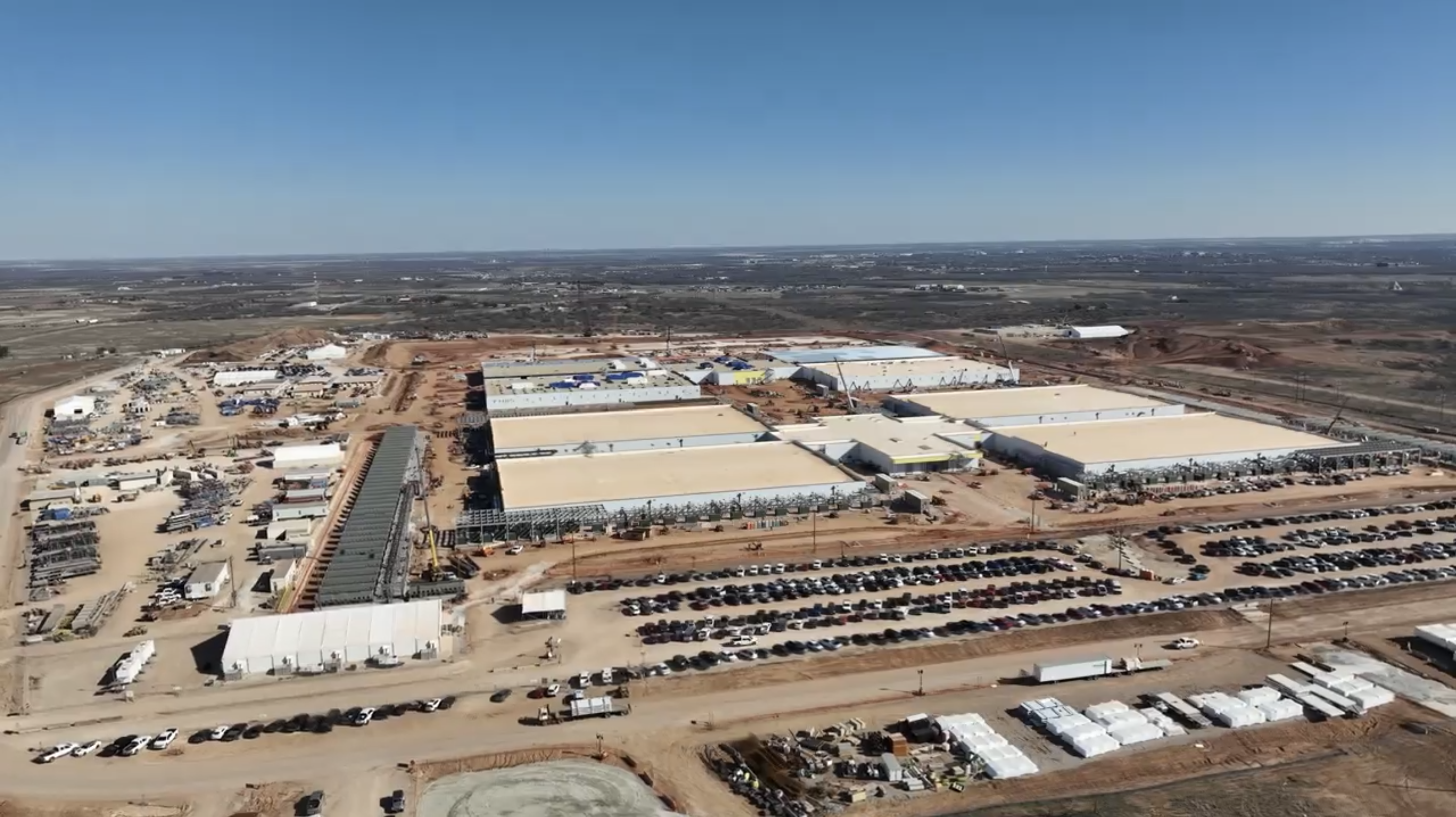
Meanwhile, in Abilene, Texas, OpenAI is constructing a parallel Stargate campus to ensure domestic compute capacity.
📌 Site specs:
- Power: 1.2 GW
- Cost: $15 billion
- Scope: 8 buildings with 400,000+ NVIDIA B200 GPUs
- GPU vendor: NVIDIA, with Blackwell architecture
- Phase 1 launch: Mid-2025 (2 data center buildings)
This initiative provides U.S.-based resilience and demonstrates a multi-continent architecture strategy for OpenAI — one that balances geopolitical diversification with compute sovereignty.
4 Mega Trends Defining AI Infrastructure
The Stargate Project is not an isolated initiative — it’s part of a sweeping global transformation of AI infrastructure.
1️⃣ Exponential Growth in Compute Requirements
AI models are growing quadratically in parameter count and complexity. GPT-4 required millions of GPU hours; GPT-5 and future models will require tens or hundreds of millions. That means infrastructure must scale at an unprecedented pace.
Technical needs:
- GPU clusters with NVLink / InfiniBand
- AI-optimized networking (RDMA, 400G+ Ethernet)
- High-bandwidth memory (HBM3/4)
- Direct-to-chip liquid cooling
- Fault-tolerant distributed training infrastructure
2️⃣ New Capital: From Oil to AI
The capital behind AI infrastructure is shifting. It’s not just coming from Silicon Valley anymore — it’s coming from sovereign wealth funds, energy companies, and infrastructure banks.
- G42 – UAE’s dedicated AI fund, investing in compute
- Crusoe Energy – Repurposing flared gas into electricity for AI
- BlackRock, Brookfield – Eyeing AI data centers as new infrastructure asset class
3️⃣ Site Selection Strategy Has Changed
Old data centers were optimized for cost and cooling.
AI data centers are optimized for scale, latency, and geopolitical resilience.
New considerations include:
- Proximity to major population centers (low inference latency)
- Access to renewable energy and grid flexibility
- Fiber connectivity for fast multi-cloud networking
- Political reliability and regulatory predictability
This is why cities like Phoenix, Tokyo, Frankfurt, and Singapore are emerging as AI data infrastructure hubs.
4️⃣ U.S. Tech Still Controls the Stack
Despite the global spread of infrastructure, the U.S. remains the central authority over compute.
Why?
- NVIDIA holds 80%+ of the AI GPU market
- Major models (GPT, Gemini, Claude) are all U.S.-based
- Export regulations prevent adversarial access to key hardware
- U.S. clouds (AWS, Azure, GCP) run ~65% of the world’s AI workloads
Equinix – The Digital Core of AI

While Stargate captures headlines, the real AI infrastructure backbone is run by firms like Equinix — which quietly power interconnection between clouds, applications, and compute clusters.
What is Equinix?
Equinix operates 250+ data centers in 70+ global markets, enabling secure, high-performance interconnection between networks, clouds, and edge devices.
They don’t run AI models — they host and connect the infrastructure that does.
1. Business Overview
- Founded: 1998
- Headquarters: Redwood City, California, USA
- Founders: Jay Adelson, Al Avery
- CEO: Adaire Fox-Martin (previously Charles Meyers)
- Industry: Global data centers, interconnection services (REIT structure)
- Revenue Model:
- Colocation services (rack, cage, suite rentals)
- Interconnection ports and xScale hyperscale services
- AI/cloud workload-ready data centers
- Core Clients: Cloud & IT firms, financial institutions, ISPs (primarily B2B)
2. Profitability, Growth, Financial Ratios & Revenue Trends
🔹 Revenue Trend (2019–2024)
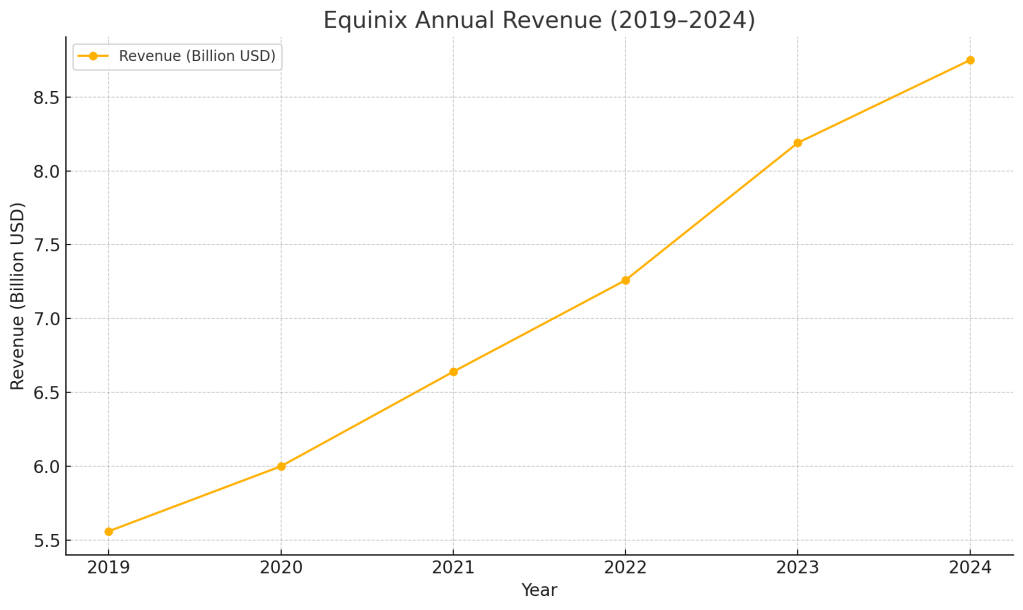
| Year | Revenue (Billion USD) | YoY Growth (%) |
|---|---|---|
| 2019 | 5.56 | +9.7% |
| 2020 | 6.00 | +7.9% |
| 2021 | 6.64 | +10.6% |
| 2022 | 7.26 | +9.5% |
| 2023 | 8.19 | +12.7% |
| 2024 | 8.75 | +6.8% |
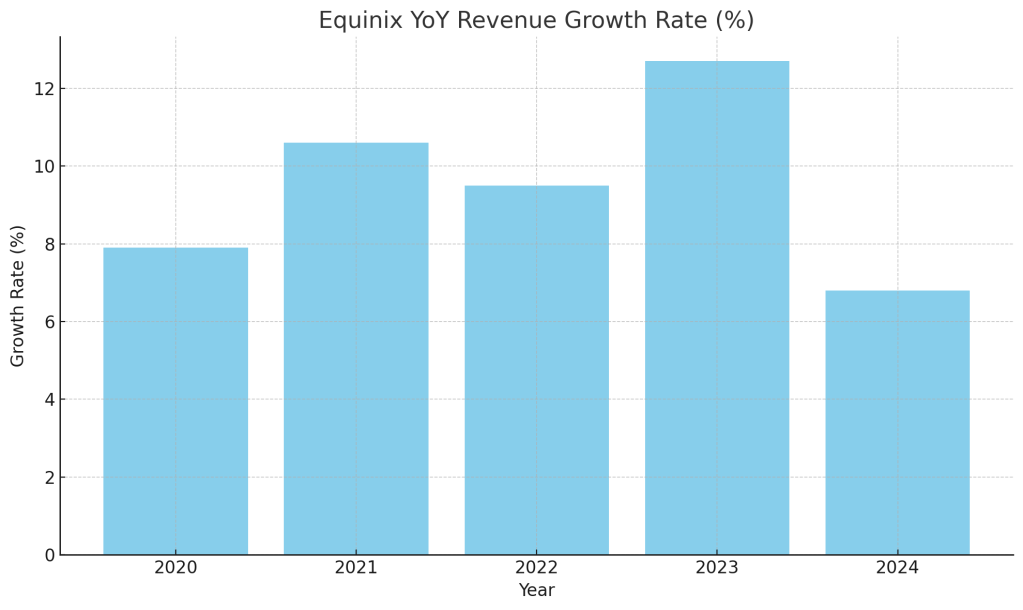
- 5-year CAGR: ~9.1%
- Q1 2025 Revenue: $2.225B (+4.6% YoY)
🔹 Profitability
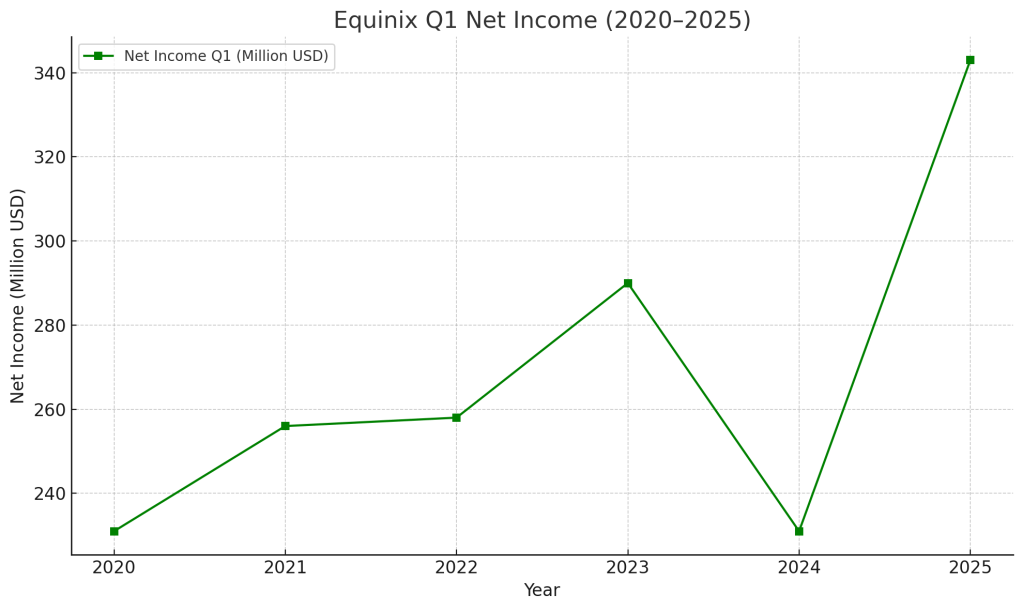
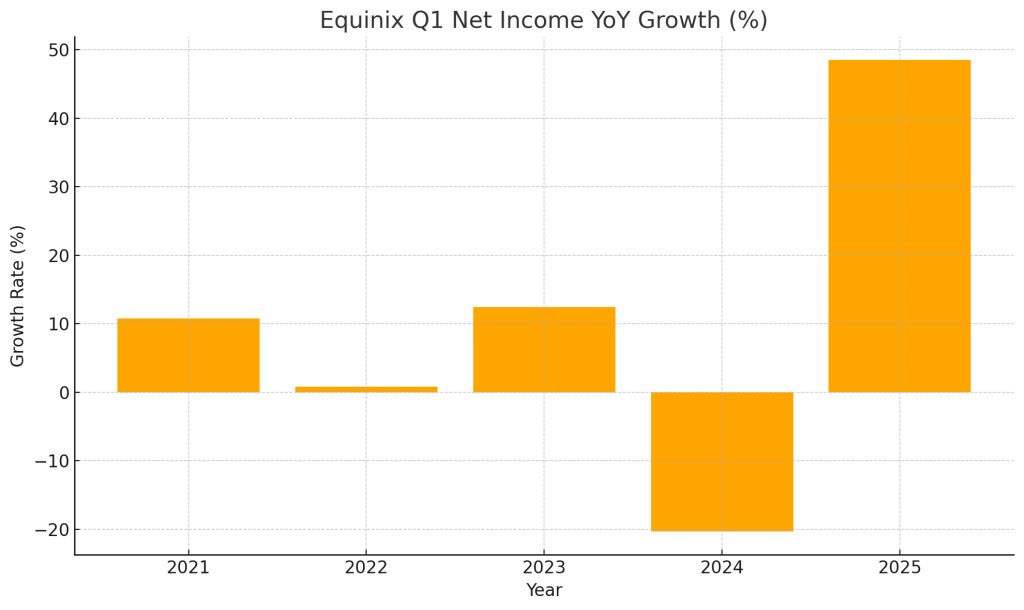
- Net Income Q1 2025: $343M (+48.5% YoY)
- AFFO Growth: 7–10% YoY expected for 2024–25
🔹 Key Financial Ratios (2024)
- PER: 92x
- P/B Ratio: 6.22
- EV/Sales: approx. 11–13x
3. SWOT Analysis
Strengths
- 260+ IBX data centers in 70+ metros across 5 continents
- Strong xScale hyperscale partnerships with PGIM, CPPIB, GIC
- Robust recurring revenue, >10,000 customers, 2,100+ network providers
Weaknesses
- High capital expenditure structure (>30% of revenue in 2023)
- Forex risk, client concentration
Opportunities
- Surging AI/cloud infrastructure demand
- Asia and Africa market expansion (Philippines, Malaysia, Kenya)
- Sale of minority Hong Kong stake to recycle capital
Threats
- Hindenburg report raised AFFO manipulation concerns
- Rising competition from AWS, Azure building in-house data centers
- Power grid and sustainability pressure due to AI workloads
4. 10-Year Forecast (2025–2035)
- Growth Path: Annual revenue expected to double to $17–18B with ~8–12% CAGR
- Profitability Leverage: Efficiency upgrades and optimized CAPEX expected to enhance margins
- Risk Management: Restoring trust through accounting transparency and CAPEX control is key
- Key Strategic Moves: Asset-light model in new markets, AI-ready expansions, xScale partner optimization
✅ Summary Table
| Metric | Status/Trend |
|---|---|
| Revenue Growth | CAGR ~9% (2019–2024) |
| Profitability | Strong Net Income & AFFO expansion |
| Financial Health | High PER, efficient cash flow, high CAPEX |
| SWOT Highlights | Strong global scale, some accounting pressure |
| 10-Year Outlook | Revenue 2x potential, margin leverage |
Why Equinix Is Critical in the AI Age
AI workloads are complex and distributed. You may train a model in Virginia, store datasets in Oregon, and run inference in Tokyo — Equinix connects it all in real time.
Core Capabilities:
- Equinix Fabric: Software-defined interconnection between AWS, Azure, GCP
- Equinix Metal: Bare-metal as-a-service, great for GPU cluster colocation
- Metro Edge: Close-to-user inference delivery with low latency
- xScale™: Hyperscaler-grade infrastructure for large AI tenants
Use Cases: Where Equinix Powers AI
📌 AI Startups
Startups lacking their own data centers can colocate GPU clusters via Equinix Metal while retaining flexible multi-cloud interconnects.
📌 Fortune 500 AI Deployments
Global retailers, logistics firms, and manufacturers use Equinix to deploy AI-based vision systems close to warehouses, stores, and factories.
📌 Sovereign AI Strategy
Governments and defense entities use Equinix for trusted AI infrastructure that respects data localization laws and jurisdictional sovereignty.
The Global AI Infrastructure Battle
Let’s not forget — infrastructure isn’t just technical.
It’s economic leverage, strategic control, and geopolitical soft power.
The New Geopolitics of Compute
- U.S. maintains control over critical chips and IP
- China invests in domestic AI GPU production (e.g., Biren, Moore Threads)
- Europe focuses on AI governance and sovereign clouds
- Gulf states pivot oil wealth into digital infrastructure
The result is a global scramble for compute independence — and AI data centers are the front line.
AI Infrastructure is the New Oil
Just as pipelines and refineries powered the industrial age, AI data centers, interconnects, and compute clusters power the intelligence age.
- OpenAI builds the engines.
- Microsoft funds the fuel.
- NVIDIA delivers the horsepower.
- Equinix builds the roads.
The companies that control the flow of compute — not just the models — will ultimately shape the future.





 Boss Brief
Leave a comment