
When people talk about Donald Trump’s second term, they often focus on the man at the top. But if you look closely at Washington’s machinery, the real hand on the levers—the one drafting the directives, bending agencies, and bulldozing through institutional resistance—belongs to Stephen Miller.

Jason Zengerle’s profile in The New York Times paints a stark picture: Miller is not simply an adviser. He is an ideologue with conviction, a bureaucratic enforcer without hesitation, and a strategist willing to absorb backlash if it means results. And in Trump’s second administration, he wields far more power than ever before.
“Just do it. If they sue, they sue.”: A Method of Bureaucratic Domination

In Trump’s first term, Miller became the face of hardline immigration: the “Muslim ban,” family separations, asylum restrictions. Yet he was often checked—by courts, cabinet secretaries, or reluctant bureaucrats.
Now, as Deputy Chief of Staff with direct sway over DHS, ICE, and even DOJ, his commands bite deeper. He has ordered raids not just on violent offenders but on day laborers outside Home Depots or corner convenience stores. Those crackdowns triggered protests; protests prompted troop deployments; tensions escalated into national crises.
This is not just policy—it is choreography. Miller has mastered the cascade of enforcement → resistance → escalation. And in a White House with little internal resistance, his approach defines the tempo.
Lessons From the Legal Battlefield: America First Legal

During Trump’s interregnum, while others cashed in as lobbyists, Miller built America First Legal (AFL), a conservative counterweight to the ACLU. AFL weaponized lawsuits against Biden’s initiatives on voting rights, DEI programs, LGBTQ protections, and more.
Two lessons hardened Miller’s strategy:
- Institutions are not obstacles but tools. Courts can be forum-shopped; injunctions can be anticipated or even exploited.
- Litigation is a policy accelerator. By the time a case winds through appeals, enforcement has already reshaped the ground.
That experience gave him what he now deploys: a policy engine where drafting, execution, and legal defense are fused into one system.
The Ideological Core: “Mass immigration shifts politics left.”

Raised in progressive Santa Monica, Miller became a contrarian conservative. His enduring thesis: large-scale immigration pushes politics leftward.
His policy triangle follows naturally:
- Reduce numbers: restrict legal and illegal flows alike.
- Display control: high-visibility raids and deportations.
- Exploit legal gaps: resurrect obscure statutes like the Alien Enemies Act to justify sweeping expulsions.
It is a program not just of immigration control, but of political engineering.
Trumpism vs. Millerism: Alignment and Friction

On most days, Trump and Miller appear perfectly aligned. Trump gets what he craves—a packaged show of power—while Miller provides ideological consistency. Yet there are cracks:
- Trump has occasionally backed H-1B visas or “investor visas” for wealthy immigrants.
- Miller sees compromise as corrosion, preferring the unbroken line of restriction.
Polling already shows majority disapproval of Trump’s immigration handling (57% negative). If the politics sour, Trump may pivot. Miller, bound by conviction, might not. That potential split is the fault line beneath their alliance.
Stress-Testing Democracy: Power, Process, and Capacity

Miller’s second-term playbook pushes American democracy across three boundaries:
- Power-sharing: executive orders and agency directives sidestep Congress. Courts’ narrowing of universal injunctions makes the presidency’s accelerator even lighter.
- Due process: invoking archaic statutes like the Alien Enemies Act tests the constitutional floor of rights.
- Administrative capacity: mass raids and deportation flights strain budgets, manpower, and local cooperation. Execution gaps may reveal themselves even as images flood the news cycle.
In short, Miller is turning policy into theater and theater into politics—but execution risks lag behind spectacle.
Why It Works: Simplicity and Spectacle
Miller’s genius is communicative. One photo—planes of deportees, soldiers in Los Angeles, a raid in progress—delivers visceral clarity. Complex statutory regimes are condensed into a three-word message: Order. Punish. Remove.
This is politics as imagery. In a noisy landscape, simplicity wins.
The Open Question: How Long Can It Last?
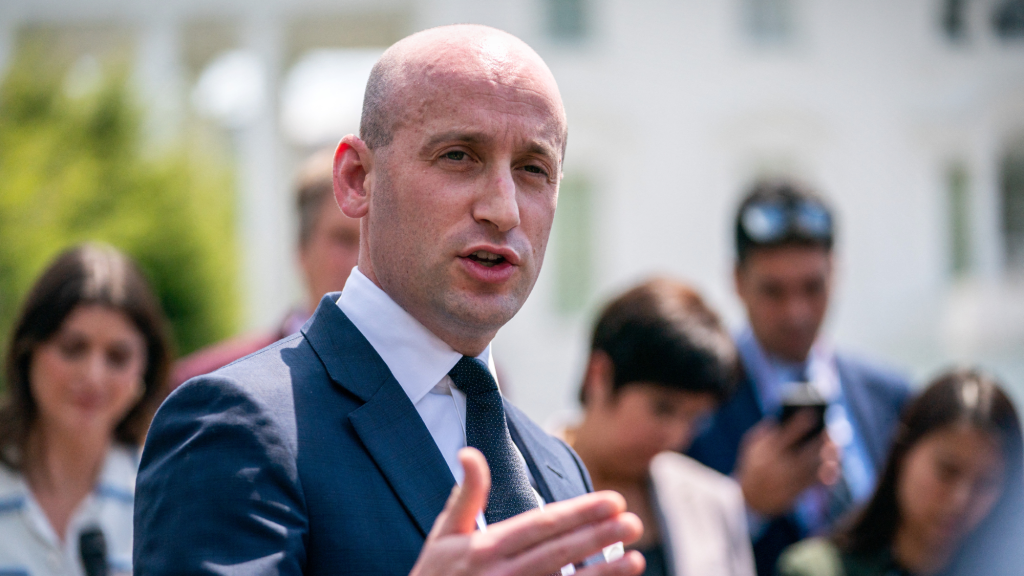
Miller’s grip looks strong but is not guaranteed.
- Public fatigue could rise as raids disrupt industries and communities.
- Bureaucratic quiet resistance may reemerge in agencies stretched too thin.
- Trump’s own instincts—deal-making, brand-building—may force compromises Miller resists.
For now, however, Miller has achieved something he only dreamed of in Trump’s first term: he is not just shaping policy, but setting its very rhythm.
Conclusion: Efficiency at the Edge of Danger
Stephen Miller is more than an ambitious aide. He has built an apparatus that turns Trump’s instincts into coherent, enforceable, and headline-grabbing programs. It is ruthlessly efficient, but perilously destabilizing.
Democracy is ultimately judged by how it handles such stress tests. Right now, Miller is not just taking the test—he is writing the questions.




 Boss Brief
Leave a comment