

“Do we really want to become stupid?”
That’s how David Brooks, veteran New York Times columnist, opens his warning about the creeping intellectual decay driven by artificial intelligence.
Brooks concedes that AI has enormous potential — for science, medicine, personal tutoring, even vacation planning. But he argues that it also offers a seductive and dangerous illusion: the promise of excellence without effort.
“The idea that you can have great thoughts without the hard work of thinking,” he writes, “is a lie — and a very tempting one.”
When Machines Think for Us
A new, still-unreviewed study from MIT professor Nataliya Kosmina and her team captured that temptation in a controlled setting.
Fifty-four participants were asked to write essays.
One group used AI.
One used search engines.
One used nothing but their own minds.
At first glance, the AI essays looked impressive — packed with names, dates, and facts. But they all sounded eerily similar.
Essays written by hand and mind were less polished, yet more original, more human.
When researchers asked participants to quote their own work, 83% of the AI users struggled. They could not recall their own words. Their thoughts, borrowed from a machine, had left no trace in memory.
Those who wrote unaided, by contrast, remembered almost everything. They took ownership of their ideas because they had built them — neuron by neuron, thought by thought.
The study summed it up:
“The brain-only group experienced greater cognitive load but also deeper learning and stronger authorial identity. The LLM group benefited from efficiency, but memory traces were weak and self-monitoring diminished.”
In other words: the harder the work, the deeper the reward.
And the more efficient the process, the less thinking we do.
Thinking, Outsourced
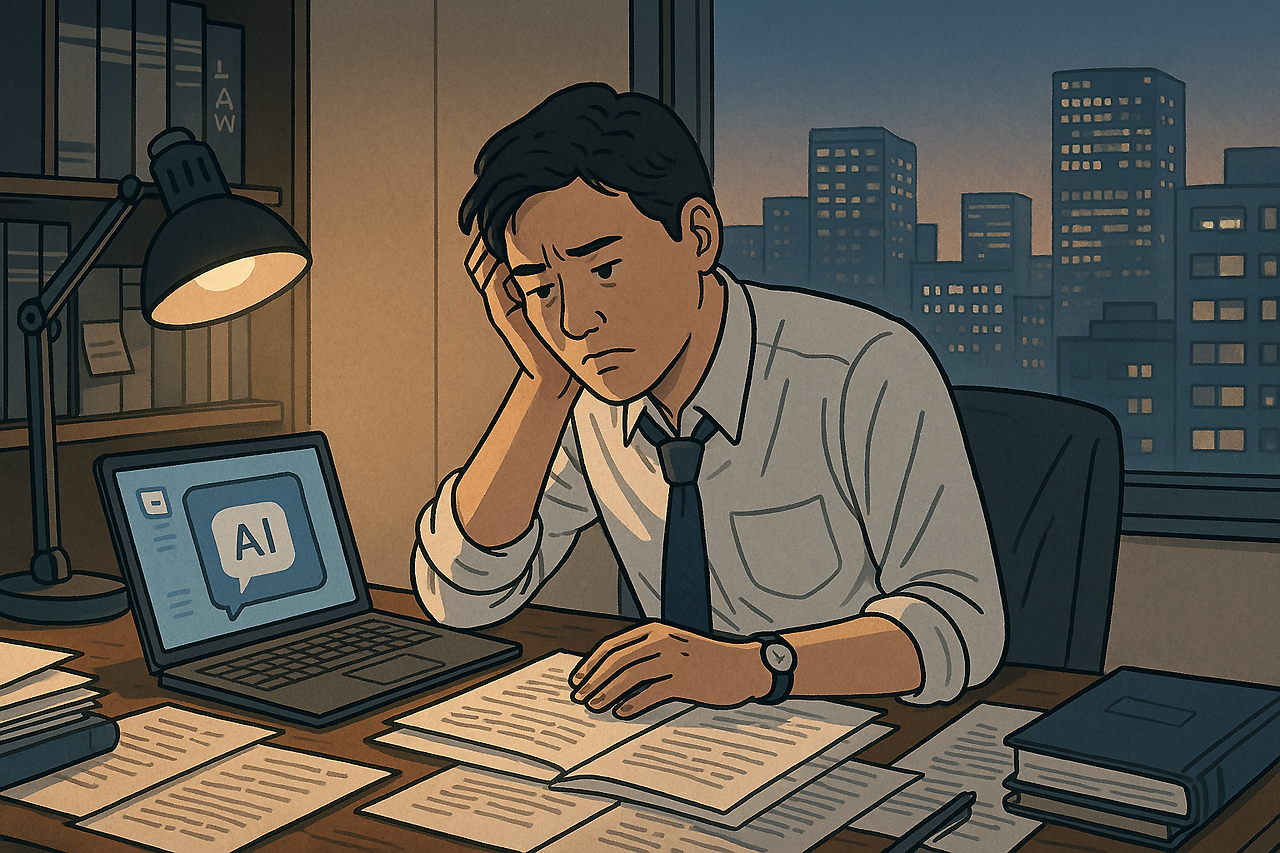
Then came the truly disturbing part.
Using EEG headsets, researchers measured each participant’s brain activity.
Those who thought for themselves showed widespread, dynamic neural connectivity.
Search-engine users ranked lower.
AI users — lowest of all.
The team used a method called Dynamic Directed Transfer Function (DDTF) to track neural coherence — how efficiently regions of the brain talk to each other.
AI use, they found, cut neural connectivity by up to 55%.
Search users dropped 34–48%.
“External cognitive tools,” the researchers wrote, “do not merely change how tasks are performed; they reshape the underlying architecture of cognition itself.”
Brooks translates that into plain language:
“Hard thinking is to the mind what exercise is to the body.
Using AI to think for you is like sending your brain to the couch.”
AI, he concludes, is mental empty calories — a frictionless, flavorless substitute for genuine effort.
The Death of Learning
Nobody knows how many students now use AI for their assignments.
OpenAI claims one in three. Brooks thinks it’s far more.
“When I asked a lecture hall of college students who used AI,” he recalls, “nearly every hand went up.”
What begins as a research aid quickly becomes an intellectual crutch.
“We start by letting AI outline our notes.
Then, under pressure, it begins writing our thoughts.
Before long, we’re not thinking at all.”
At a recent conference in Utah, one professor told Brooks something chilling:
“We spend all our energy worrying about Trump’s threat to democracy.
But it’s AI that might actually kill us.”
From the Classroom to the Couch

Brooks cites a New Yorker piece by Hua Hsu, who interviewed a student named Alex.
Alex first claimed he used AI “just for note-taking.” Later he confessed:
“I use it for everything — even texting girls.”
College workloads have dropped — from 25 study hours per week in the 1960s to barely 15 by 2015 — but students feel busier than ever, drowning in distractions, internships, and notifications.
So they turn to AI not to learn better, but to cope.
“AI won’t disappear,” Brooks writes. “The real question is motivation. Do we want to free up time — or to grow our minds?”
“If you want to get stronger, go to the gym.
If you want better judgment, you must read and write for yourself.”
Some people, he notes, use AI to expand thought — to learn, explore, and question more deeply.
But others use it to avoid thought — to skip the mental sweat that learning requires.
Brooks’s conclusion:
“Society needs more stigma, not less, around using AI to think less.
Because thinking less means being less.”





 Boss Brief
Leave a comment