
JD Vance shouldn’t matter this much.
Yes, he is the vice president of the United States — a title that once carried real political gravity.
But unlike Gore modernizing government or Cheney running the post-9/11 response, Vance has no portfolio, no influence, and no genuine political authority inside the White House.

He arrived without a real political base, without experience, and without a coherent vision of governance.
He is, in many ways, a creature built by two forces:
- Peter Thiel’s money
- Donald Trump’s dominance of the GOP
What Vance has instead of power is time.
And the way he’s spending it is what makes him important.
From Margins to the Fault Line: Vance and the New Extremist Right
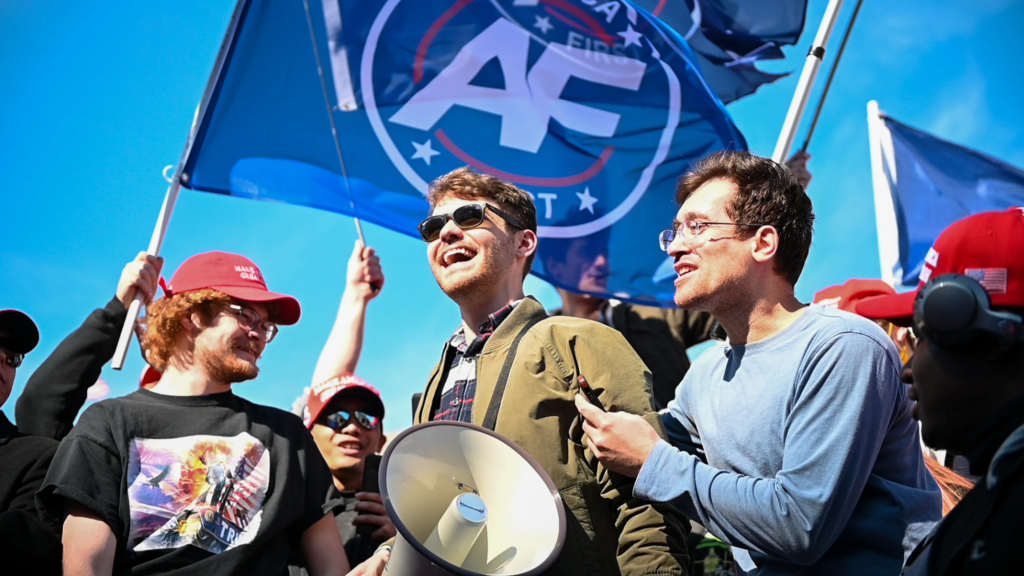
Vance has drifted toward the outer rim of the Republican coalition — the space where the party’s traditional conservatives collide with the rising “Groyper” movement, a loose but increasingly influential extremist network.
At the center of that movement is Nick Fuentes, perhaps the most notorious neo-Nazi in the country today.
Fuentes openly praises Hitler, denies the Holocaust, and advocates for a white ethnostate.
This once-fringe actor suddenly received prime-time oxygen when Tucker Carlson invited him onto his platform for a friendly interview.
Carlson did not challenge a single antisemitic claim.
The backlash inside conservative institutions was immediate.
The Heritage Foundation, tightly aligned with Carlson, refused to distance itself. Instead, its president defended him:
“We’re not abandoning Tucker. We’re with him.”
The result: The conservative world split into two camps.
- The Carlson–Fuentes–Heritage axis
- The Ben Shapiro / Lindsey Graham “No Nazis in the GOP” bloc
And right in the middle of this escalating fight sits Vance — silent, calculating, watching.
Vance’s Strategy Is Simple: Say Nothing, Signal Everything
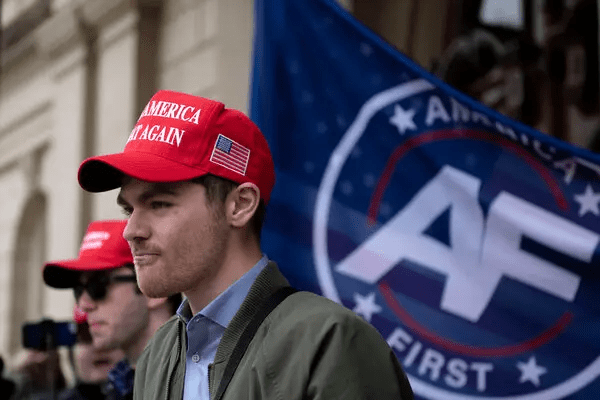
When the controversy exploded, Vance refused to condemn Fuentes, Carlson, or the Groyper movement.
Instead, he issued a sanitized, meaningless plea against “infighting.”
To extremist networks, his silence was not neutrality — it was encouragement.
And Vance reinforces that impression with his rhetoric.
This week, he said:
“Young people can’t afford homes because we filled the country with 30 million illegal immigrants who are taking housing that should go to American citizens.”
There aren’t 30 million undocumented immigrants.
There is no evidence they drive housing shortages.
This is not economic analysis — it’s scapegoating and dehumanization.
It mirrors his behavior during the campaign, when he repeated the false rumor that Haitian immigrants were stealing and eating neighborhood pets in Ohio.
Vance gravitates toward the cultural, racial, and conspiratorial instincts of the far-right…
even when he refuses to explicitly join them.
Vance’s Nationalism Has a Clear Shape — and It Isn’t Civic
Vance rejects the founding American idea of a civic nation.
He views “real Americans” as those whose lineage reaches back to the 18th and early 19th centuries.
Newer immigrants, even legal ones, must “earn” their right to criticize or participate in shaping the nation.
Strip the rhetoric down and compare it:
- Vance: Deport “illegal foreigners” who threaten the national character.
- Fuentes: Create a white ethnostate by removing non-white populations.
The difference is one of tone, not principle.
Vance is the respectable suit version of the same worldview: exclusionary, racialized, historically revisionist.
A Vice President Without Power but Full of Influence
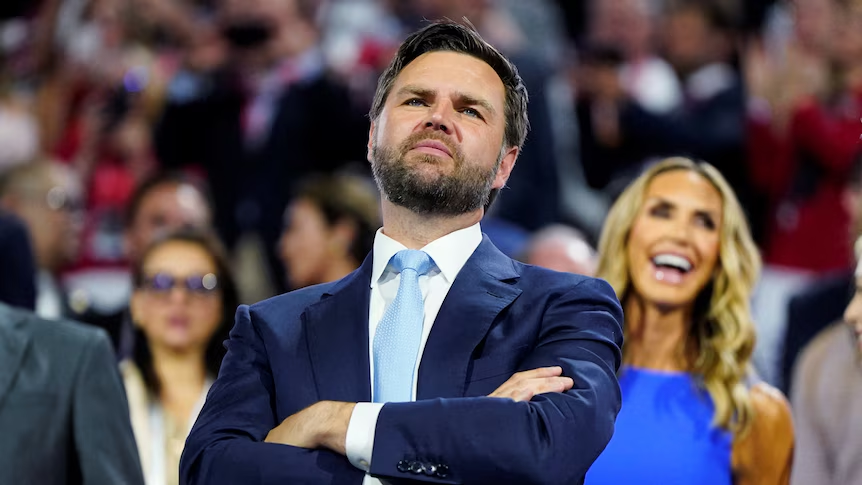
Vance is not shaping policy.
He is shaping the party’s emotional temperature —
and he is doing it by legitimizing the most reactionary instincts in the GOP.
His political instincts are opportunistic:
avoid alienating Trump’s extremist online base, avoid press blowback, avoid taking any moral risks.
He is a politician drifting toward whichever faction feels ascendant.
But the danger is this:
A powerless vice president who refuses to reject extremism gives extremists power they never had.
He tells them:
“You are part of the coalition. You are not too toxic. You can stay.”
In an age where the GOP is already sliding toward authoritarian populism,
that signal matters.
Vance Is a Barometer, Not a Leader?
JD Vance is not an ideological warrior, nor an architect of Republican politics.
He is a barometer — a sensitive instrument that tilts toward whichever direction the party is drifting.
Right now, the needle points clearly toward the ascendant far-right.
Vance is the proof:
a vice president with no real duties
who spends his time cultivating proximity to extremists
has revealed more about the GOP’s future than any policy document or campaign speech could.
His “powerlessness” is the tell.
He doesn’t have to lead to move the party.
He simply has to refuse to say “No.”
And he isn’t saying it.



 Boss Brief
Leave a comment